
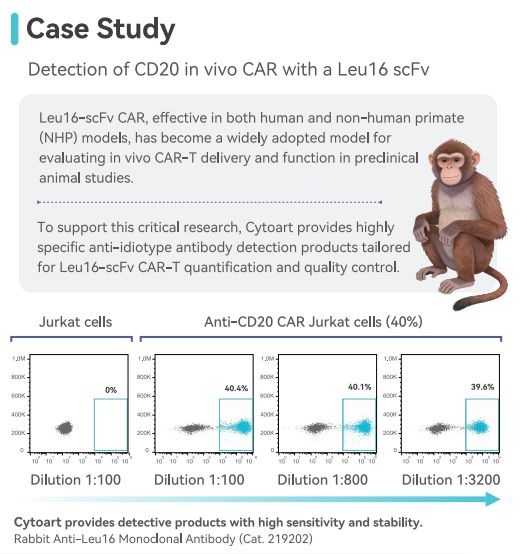
While their CAR construct and preclinical animal models functioned well, the project was trapped by unstable CAR detection results: inconsistent test signals and high non-specific background hampered accurate quantitative analysis, which greatly delayed the overall R&D progress. The team had screened all commercially available detection reagents on the market without finding a feasible solution.
The client discovered CytoArt’s technical introduction via LinkedIn and initiated technical communication. Unlike single-clone products from other suppliers, CytoArt provides a full panel of diversified anti-Leu16 anti-idiotype antibody clones. After sample verification, the client selected the optimal clone matching their proprietary CAR structure and placed successive bulk orders for long-term study. The biotech company was eventually acquired after successful project advancement.
From abundant practical projects, CytoArt summarized an industry pain point: identical Leu16 scFv sequence paired with distinct CAR backbones leads to varied detection performance; in vivo and NHP preclinical research tends to generate high assay background, making reliable CAR quantification a universal industry bottleneck, where a single antibody clone cannot satisfy all project demands.
To resolve such challenges, CytoArt developed a comprehensive anti-Leu16 anti-idiotype antibody library. To further improve detection quality, we newly launched the second-generation F(ab’)₂-format antibodies featuring lower background and superior stability under in vivo experimental conditions.
CytoArt provides free evaluation samples covering both conventional and newly upgraded second-generation products for researchers developing Leu16-based in vivo CAR and NHP preclinical models.