VHH Development Service
Efficient Construction · Precision Delivery
VHHs are single-domain antibodies derived from the heavy chain-only antibodies of alpacas, with a molecular weight only one-tenth that of conventional antibodies. Their small size and high tissue penetrability enable superior tumor and blood–brain barrier penetration. As a result, VHH nanobodies offer unique advantages in in vivo CAR, including CAR construction and T cell targeting.
CytoArt is actively developing a diverse portfolio of VHHs targeting high-potential therapeutic targets. Our VHH development platform enables rapid timelines (starting from 20 weeks), achieves picomolar-range binding affinity, and demonstrates strong human-NHP cross-reactivity–supporting efficient in vivo CAR-T development.
We look forward to discussing your target-specific needs and providing customized solutions tailored to your requirements. Join us in advancing the development and translation of innovative cell therapies!
Applications
CAR Construct Design
Serve as the antigen-binding domain in CAR-T cells, provide exceptional high-affinity binding with low-immunogenicity.
T/NK Cell–Targeted Delivery
Engineered into in vivo CAR-T/NK delivery vehicles (e.g., lentiviral vectors, LNPs) to enable specific T/NK cell recognition and precise delivery.
Development Process
CytoArt has established an advanced alpaca VHH development platform, supported by a highly skilled and experienced R&D team, dedicated to delivering high-quality VHH discovery services.We offer a comprehensive, end-to-end solution spanning antigen preparation, immunization and titer evaluation, antibody screening, and functional validation to support your diverse needs.
1. Immunogen Preparation
2. Target Cell Line Establishment
3. Immunization & Serum Titer Monitoring
4. PBMC Isolation
5. Phage Display Library Construction, Panning & Screening
6. Small-Scale Antibody Expression & Validation
7. Lead Candidate Delivery
Case Study
Anti-BCMA VHH Development
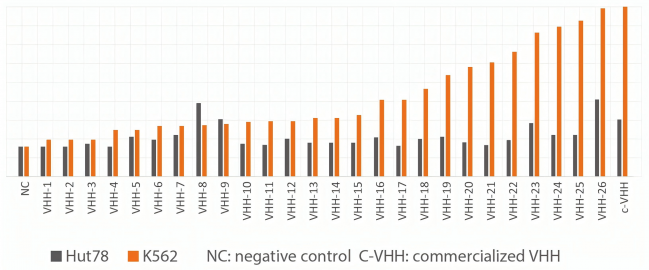
The bar chart shows the mean fluorescence intensity (MFI) of anti-BCMA candidate VHHs and commercialized anti-BCMA VHHs in Hut78 and K562 cell lines, both of which are BCMA-negative. Our candidate VHHs exhibit lower non-specific binding compared with the commercialized ones, as reflected by their lower MFI values.
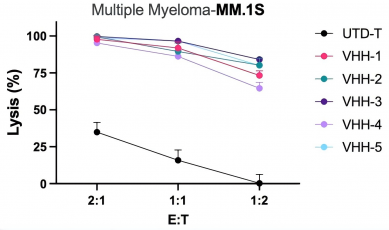
The selected anti-BCMA VHH candidates were constructed into a CAR structure and transduced into T cells to generate VHH CAR-T cells. BCMA-positive MM1S cells were used as target cells, and co-cultured with VHH CAR-T cells at effector-to-target (E:T) ratios of 2:1, 1:1, and 1:2. VHH CAR-T cells exhibited dose-dependent cytotoxicity against MM1S cells, with increasing lysis rates observed at higher E:T ratios, demonstrating potent and specific killing activity.