
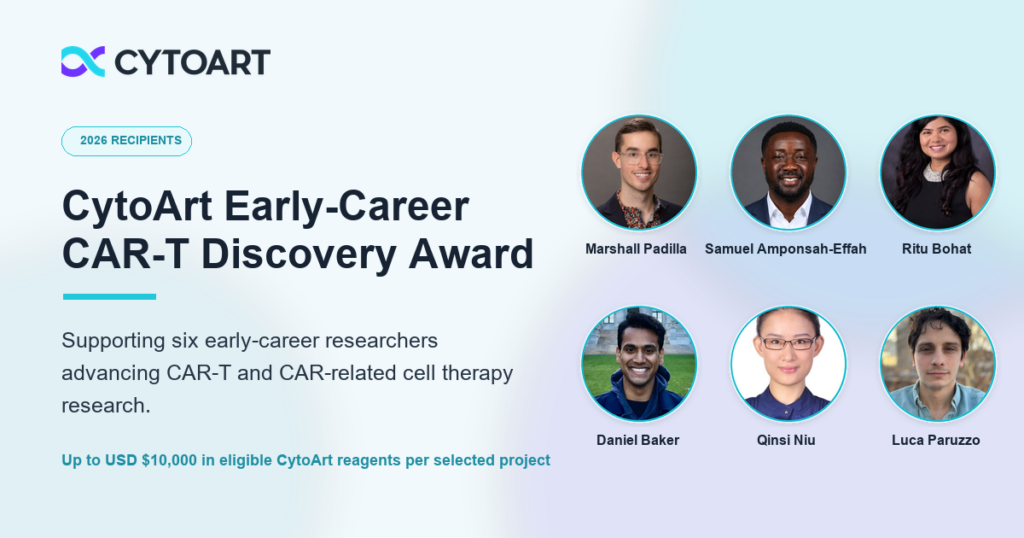
CytoArt is pleased to announce the 2026 recipients of the CytoArt Early-Career CAR-T Discovery Award.
The award was created to support early-career researchers who are asking important questions in CAR-T and CAR-related cell therapy research, and who need practical research tools to move promising ideas into experimental validation.
This year's selected projects reflect where the field is moving: in vivo CAR-T engineering, long-term CAR-T persistence, AI-guided CAR design, CAR-NK biology, tumor microenvironment resistance, and controlled activation strategies for cellular immunotherapy.
Each selected project will receive up to USD $10,000 in eligible CytoArt reagents to support research use during the award period.
2026 Award Recipients

Dr. Marshall Padilla
Assistant Professor of Materials Science & Engineering and Sarafan ChEM-H Institute Scholar
Stanford University
Dr. Padilla's project explores in vivo CAR-T engineering through the co-delivery of CAR RNA and siRNA. The work aims to support more programmable approaches to cell therapy development while using CytoArt reagents to support experimental detection and validation.

Samuel Amponsah-Effah
PhD Student
Department of Neurosurgery, Keck School of Medicine, and Department of Biomedical Engineering, Viterbi School of Engineering
University of Southern California
Samuel's project explores tumor-to-myeloid reprogramming and focused ultrasound-controlled CAR activation as a conceptual strategy for localized cellular immunotherapy. CytoArt will support the work with reagents for CAR-related detection and immune monitoring.

Dr. Ritu Bohat
Postdoctoral Research Fellow, Rezvani Lab
Stem Cell Transplantation and Cellular Therapy
The University of Texas MD Anderson Cancer Center
Dr. Bohat's project investigates how tumor-CAF crosstalk may contribute to resistance to CAR-NK cell immunotherapy in pancreatic cancer. CytoArt reagents will support immune profiling and functional characterization in this tumor microenvironment-focused study.

Dr. Daniel Baker
Postdoctoral Fellow
Center for Cellular Immunotherapies
Perelman School of Medicine at the University of Pennsylvania
Dr. Baker's project, "Leveraging AI to reproducibly create chimeric antigen receptors," will evaluate an AI-enabled approach to improve the efficiency and reproducibility of CAR T-cell development. Candidate CAR constructs will be tested in primary human T cells, with CytoArt CAR-detection reagents used to measure surface expression and enable standardized comparisons across constructs and donors. The goal is to establish a streamlined workflow for CAR T-cell development and experimental validation.

Qinsi Niu
Prospective PhD Student
University of Otago
Qinsi Niu will pursue doctoral research under Prof. Alexander McLellan at the University of Otago, exploring CAR-NK and CAR-T combination strategies to address antigen escape and improve cellular immunotherapy responses. CytoArt reagents will support flow cytometry phenotyping and CAR-specific immune monitoring.

Dr. Luca Paruzzo
Postdoctoral Fellow, Ruella Lab
Lymphoma Program
University of Pennsylvania
Dr. Paruzzo's project will investigate why some CAR T cells persist for years after infusion and how this long-term persistence contributes to durable cancer control. The work will use CytoArt anti-CAR antibodies to detect, phenotype, and isolate rare persisting CD19 and BCMA CAR T cells from patient samples, with the goal of informing next-generation cellular therapy design.
Supporting the Next Wave of CAR-T Research
Across these six projects, the common thread is not only scientific ambition, but also the need for reliable tools to measure, characterize, and interpret engineered immune cells.
For early-stage cell therapy research, good ideas still have to become readable data. CytoArt is proud to support researchers building that bridge through better detection, better characterization, and better experimental confidence.
We congratulate all of the 2026 award recipients and look forward to supporting their work.
Learn more about CytoArt CAR-T monitoring reagents and research support at www.cytoart.com.